


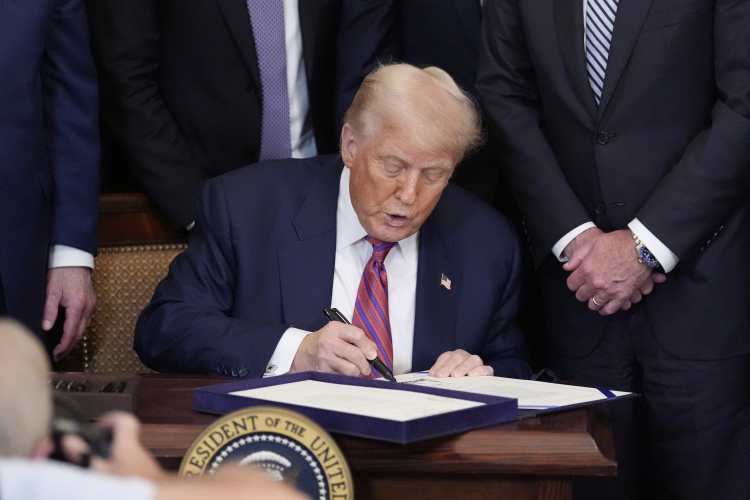
President Trump made good on his promise to make America the “crypto capital of the planet” by signing the GENIUS Act into law, the first federal regulatory framework for stablecoins. The law confirmed Washington’s firm embrace of crypto, enacting clear rules and distinctions from traditional banking the industry direly needed. The Act replaced the previous patchwork of fuzzy and unpredictable state and federal regulations which, under the Biden Administration, held crypto back through uncertainty as well as a myriad of particularly brutal SEC lawsuits against issuers and investors alike.
Crypto’s rapid embrace by federal lawmakers is nothing short of astounding, going from lawsuits to punish trading to a sitting president who issued his own $TRUMP meme coin in less than a year. It’s a true-life underdog story, with crypto not only crossing the finish line into mainstream acceptance but standing in the winner’s circle. As with any good story, the GENIUS Act now has a sequel, the CLARITY Act.
By way of analogy, one crypto commentator has likened the passage of the GENIUS Act to the legalization of cell phones and the CLARITY Act as legislation to establish the cell towers necessary for the phones to work. And regardless of whether one is deep into crypto or is partial to minted coins, the CLARITY Act has major financial implications for everyone.
The GENIUS Act’s relevance lies in the clear lines established between stablecoins and traditional banking. Yet even as crypto companies and blockchain acolytes benefit from avoiding the regulatory and cost burdens of rigid banking rules, such as adherence to the Community Reinvestment Act (CRA), Federal Reserve oversight, or FDIC insurance, they still seek to infuse their industry with consumer perks of traditional banking the Genius Act proscribes.
Chief among these benefits is the right to issue rewards to stablecoin holders, just as a bank may offer a yield on a deposit account. While the GENIUS Act expressly forbids stablecoin issuers from offering holders interest or similar financial remuneration, the industry has found a loophole by issuing rewards through crypto exchanges, the platforms where crypto is bought, sold, and converted from or into cash.
The loophole presents a clear violation of the intent of the GENIUS Act, which is why the House, on a significant bipartisan basis, closed this loophole in its version of the CLARITY Act (H.R. 3633). The bill now heads to the Senate Banking and Agriculture Committees for critical markup hearings next week where closing the loophole will take center stage.
Failure to close the current loophole would cement an enormous unfair advantage for crypto assets, tilting the financial landscape toward stablecoins and thus undermining market competition that incentivizes innovation and price stability. If a locality allowed one grocery store an exemption from collecting sales taxes, other stores in town would surely see a significant dip in sales. Government surely doesn’t need to be engaging in this kind of favoritism with our financial system.
Just as concerning would be the crippling ripple effects throughout our banking system. With stablecoins free to offer returns like a bank without being held to banking regulatory standards, banking deposits would flood toward stablecoin and put a chokehold on consumer credit, business investment, and economic growth.
The Treasury Department issued a report in April estimating as much as $6.6 trillion could flow out of banks toward stablecoins, reducing funds available for lending while also raising lending costs. This would be especially devastating in smaller communities where the population and local businesses rely on local banks that would not be able to compete against a stacked deck. Money, and eventually people, would flow out, never to return.
The impact on deposits can’t be understated as the capital that makes financial lending possible for every American with a credit card, a car loan, a student loan, or a mortgage. With trillions of dollars siphoned from banking deposits, loans will become more difficult to obtain yet more expensive.
The Senate cannot afford to get this wrong. The direct threat of stablecoin rewards has one ending only, and without closing the rewards loophole, the sequel won’t be a happy one for most.
Gerard Scimeca is the chairman of Consumer Action for a Strong Economy.
Read Full Article »