


America’s public-sector unions have a problem they can’t explain away: Workers are leaving.
Ask a public employee when they joined their union and most couldn’t tell you. Because they didn’t join. The dues just started coming out of their check.
That’s not a membership, and for decades nobody told workers they could opt out.
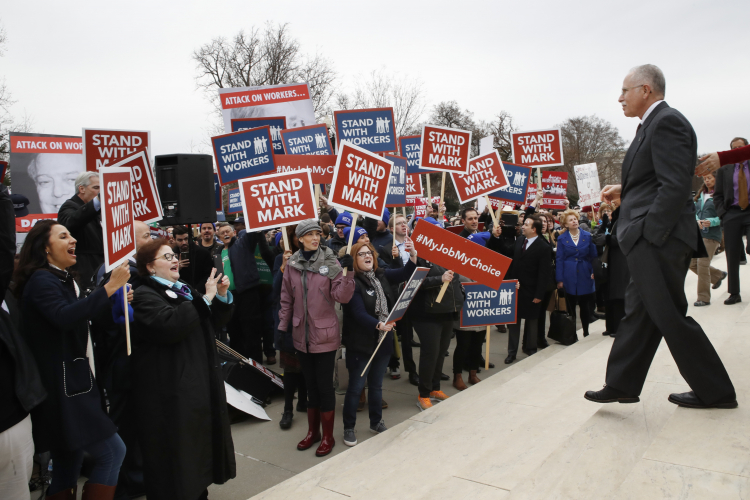
That changed in 2018, when the U.S. Supreme Court affirmed in Janus v. AFSCME that no government employee can be forced to join or pay dues to a labor union.
Hundreds of thousands opted out the moment they found out— the Freedom Foundation alone has helped more than 265,000 workers exercise their First Amendment rights since the ruling was issued.
Union leaders don’t talk about that number.
For decades, public-sector unions ran on automatic — automatic dues collection, automatic membership, automatic political spending — whether the worker wanted it or not.
The National Education Association confiscated $390 million in dues revenue during the most recent fiscal year from nearly 2.9 million members — most of it seized directly from taxpayer-funded paychecks before the workers could even see it.
In California alone, public education unions are estimated to collect more than $800 million per year. That money doesn’t come from convincing workers the union is worth it. It comes from a system designed so workers never had to be asked.
When the Supreme Court exposed their scheme in Janus, unions had to find other ways to keep the cash spigot open — including literally criminalizing their opposition.
Oregon, for example, effectively passed a law last year making it illegal to send public employees a mailer explaining their right to opt out. In theory, the law only bans marketing materials whose sender attempts to deceive the recipient into believing it was sent by their union. But in practice, the legislation is written so broadly that a left-leaning judge could easily construe nearly any outreach to union members as such an impersonation, subjecting the sender to potentially hundreds of thousands of dollars in fines.
To be clear, the law is specifically intended to thwart the Freedom Foundation, which has helped thousands of public-sector union members in Oregon opt out of their union. And other blue states are following suit.
New York lawmakers are currently considering an identical bill. In Hawaii, a similar measure has already cleared its second legislative committee.
The bills use the same language because the same people are writing them. Union-backed legislators, coordinating across state lines, are abusing their power to impose laws designed to prevent workers from understanding their First Amendment rights.
If you have to pass a law to stop people from finding out they can leave, you've already lost the argument.
This is Big Labor’s playbook. Unions are forging worker signatures on membership applications, signing people up without asking them, then taking dues from their paychecks. When workers try to resign, the union hands them documents they'd never seen, let alone signed.
Chaquan May, a California caregiver and mother, described what happened when she first encountered SEIU 2015 representatives at an orientation for newly hired in-home healthcare providers. “They locked us in a room,” she said. “One of the head union workers hovered over me at the table and stood there and told me, ‘What are you waiting for? Just sign it.’ I honestly felt scared and just went ahead and signed it out of fear.”
The Freedom Foundation has filed a class-action lawsuit against SEIU 2015 on behalf of May and a dozen other workers like her.
Meanwhile, the NEA’s president pulled in more than $514,000 in salary last year — a pay raise of $80,000 since she took office.
The union reported more than $51 million in disbursements for political activities and lobbying in the same period. The NEA and the American Federation of Teachers have together put $43.5 million into political organizations since 2022.
This is what the dues are for. Not the worker, the machine.
The reforms are commonsense:
- make re-enrollment annual and affirmative — if a worker wants to belong, they sign up every year
- end automatic payroll deductions so dues are a visible, conscious transaction
- require unions to disclose political spending the same way corporations have to
These are exactly the kinds of reforms Oregon, New York and Hawaii are working to prevent — not by defeating them in debate, but by making it illegal to tell workers such options exist.
Unions that fight every one of those reforms are telling you the membership numbers don't hold up if workers get a real vote. The hundreds of thousands of workers who left after Janus proved it.
The fight now is making sure that choice stays real, and that the people trying to take it away don’t succeed one forged signature, one locked room and one state legislature at a time.
Aaron Withe is the CEO of the Freedom Foundation, a nonprofit organization dedicated to protecting workers' rights and advancing employee freedom across America.
Read Full Article »
