


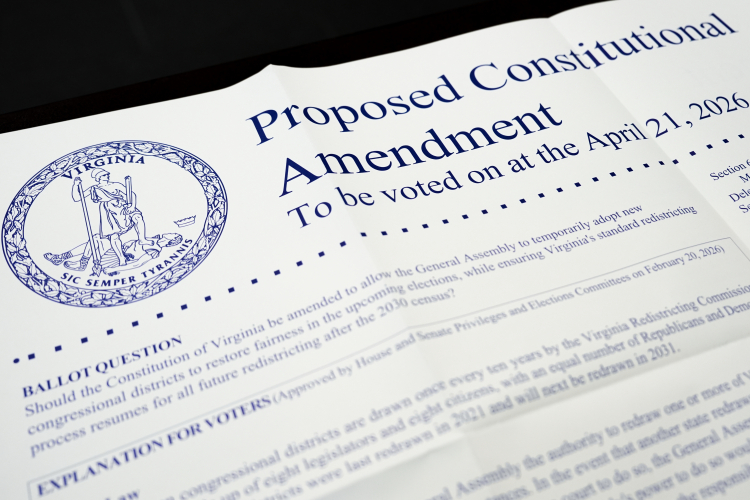
The rules for governance are meant to be steady. They were designed to outlast any one campaign, any one governor, any one majority. In a 4–3 decision over a hotly contested redistricting amendment, the Supreme Court of Virginia proved that point.
The justices invalidated a change to the state constitution that would have opened the door to partisan gerrymandering. Though narrowly approved by Virginia voters, the politicians leading the efforts had not followed the constitutional process for amendments.
The case had all the modern trappings. A plan designed to tilt congressional maps 10–1 in favor of one party; a ballot question wrapped in language about “restoring fairness;” and a narrow, statewide “yes” vote.
Virginians were asked to approve a map that would give one suburban northern Virginia county control of five separate seats. These proposed districts appeared as tentacles into the southwest and central parts of the state, ensuring that Fairfax County controlled the fate of rural representation. The proposed map was not displayed in ads or in polling places.
While 51% voted “yes,” the court examined the Virginia Constitution, looked at what the General Assembly had done, and said, in effect, “No. That is not how it's done.”
Amending the Virginia Constitution requires more than a clever campaign and a burst of enthusiasm. It requires the General Assembly to pass a proposed amendment twice, in two different sessions, with a House of Delegates election in between. Only after that intervening election can the proposal appear on a statewide ballot for voter approval.
Last fall, after more than a million Virginians had already cast their ballots, the General Assembly attempted to bypass this safeguard by declaring the election cycle that was already well underway as the “intervening election.”
Senate Majority Leader Scott Surovell argued that, “the practical realities of our election calendar” forced an accelerated timetable. The reality is that party leaders in Richmond chose to violate the Virginia Constitution to achieve their goal.
Thankfully, the highest court in Virginia refused to go along with it.
In the decision, Justice Kelsey wrote, “These procedural requirements may seem laborious to some, perhaps even painstakingly so. The ambition of a constitution, James Madison said, is to create ‘a Government for perpetuity’ grounded by ‘permanent principles and not on those of a temporary nature.’ … For this reason, amending the Constitution ‘necessitate[s] compliance with the requirements of a deliberately lengthy, precise, and balanced procedure…[S]trict compliance with these mandatory provisions is required in order that all proposed constitutional amendments shall receive the deliberate consideration and careful scrutiny that they deserve.”
This is the point at which some say the court overruled the will of the people. The ballot question, after all, did pass. That argument skips a crucial chapter.
Long before 2026, Virginians decided how constitutional changes must occur – making amendments intentionally difficult. As the decision points out, “most states during the nineteenth-century had adopted an intervening-election requirement for constitutional amendments.”
States included the intervening election as a speed bump between a first legislative impulse and a final vote of the people, insisting that altering the rules of representation takes time, notice, and a real chance for citizens to respond.
By enforcing those instructions on May 8, Virginia Supreme Court upheld the rules of a constitutional republic. The court did not choose a congressional map; the court protected the fine print of the Virginia Constitution. It did not rescue one party or punish another. It reminded both that they are bound by the same text, the same sequence, and the same obligation to all Virginians. As America approaches her 250th anniversary in July, Virginia has given us a meaningful reminder of the disciplines of a constitutional republic.
Katherine T. Bennett, a Virginia native, is director of the Process and Procedures Task Force at the American Legislative Exchange Council (ALEC).
Read Full Article »