


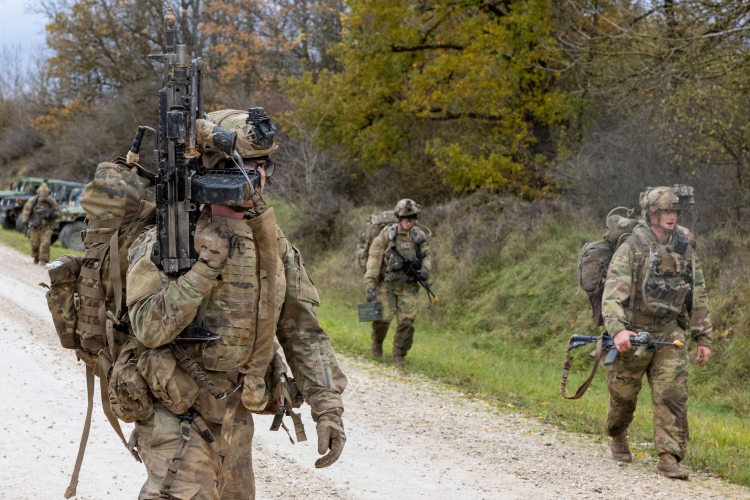
For decades, blast injuries were understood as the price of war. If service members survived explosions without visible wounds, the assumption was that they had escaped serious harm. That belief is collapsing under the weight of evidence showing that repeated exposure to blast overpressure, even at levels long considered safe, can quietly damage the brain.
Blast overpressure is the pressure wave generated by explosions or by firing heavy weapons such as mortars, artillery, and breaching charges. Unlike shrapnel or blunt force trauma, its effects are often invisible and cumulative. Service members and law enforcement officers may walk off the range feeling shaken but functional, only to develop headaches, memory problems, slowed thinking, or emotional volatility days or weeks later. For years, these symptoms were dismissed as stress or normal fatigue.
Scientific research has begun to tell a different story. A peer‑reviewed study published in Military Medicine examined Army Ranger mortarmen during training and found that repetitive low‑level blast exposure was associated with measurable neurocognitive changes. The study, led by Julia Woodall of the Wallace H. Coulter Department of Biomedical Engineering at Georgia Tech in collaboration with the 75th Ranger Regiment, documented high cumulative blast exposure over just a few days of training.
More than 70 percent of the mortarmen reported symptoms resembling mild traumatic brain injury, including headaches, memory problems, and slowed thinking, even when their average exposure remained below existing safety thresholds.
These findings echo a growing body of research showing that current standards might not capture the real risk.
The human consequences of this gap in understanding have been starkly illustrated outside academic journals. In March 2025, 60 Minutes aired “Larkin’s War,” an investigation into the death of Navy SEAL Ryan Larkin, who died by suicide after years of service and repeated exposure to blast pressure during training.
Postmortem examination revealed scarring in his brain that was caused by low‑level blasts from his own weapons. His father’s search for answers forced the military and the public to confront an uncomfortable reality. Brain injuries can accumulate undetected by standard scans and protocols.
Daniel Johnson, a former Army artilleryman and now a journalist trained at the University of North Carolina, partnered with the New York Times to examine the link between long‑range artillery crews, repeated blast exposure, and elevated rates of suicide and post‑traumatic stress symptoms.
Their reporting uncovered internal documents and medical observations indicating that soldiers firing thousands of rounds were absorbing concussive forces from their own weapons. The work became a finalist for the Pulitzer Prize and helped bring national attention to blast overpressure as a systemic occupational hazard.
The federal government is no longer treating the issue as speculative. The Department of War’s Blast Injury Research Coordinating Office, or BIRCO, was created to identify knowledge gaps and coordinate research into the prevention, mitigation, and treatment of blast injuries. BIRCO’s work reflects a recognition that blast overpressure poses risks across training, combat, and even post‑deployment instruction, and that those risks demand coordinated scientific and policy responses.
Recognition alone does not prevent injury. One of the most promising tools available is simulated training. Advances in virtual and augmented systems allow service members to practice weapons handling, tactical decision‑making, and coordination without repeated live fire. Simulation does not eliminate the need for realistic training, but it can reduce unnecessary exposure once proficiency has been achieved. The Department of War has acknowledged the value of integrating simulation into training strategies as part of blast risk management, particularly to limit cumulative exposure.
Live-fire training costs six figures per soldier over a career when counting ammunition, range fees, transportation, environmental cleanup, medical treatment, and veterans’ disability claims. Simulation costs much less. Tinnitus or ringing in the ears often caused by loud sounds is the VA’s largest disability claim affecting 3.2 million veterans.
Investigative reporting and scientific findings have prompted lawmakers to consider measures that would formalize blast exposure tracking, strengthen prevention standards, and require greater accountability. Lawmakers also should urge the Pentagon to move from studying the effects of blast overpressure to deploying training simulations that reduce it.
Blast overpressure presents a challenge that cuts across science, culture, and policy. The injury is often invisible. The symptoms can be delayed. The affected population is trained to endure discomfort without complaint. Together, these factors have allowed harm to persist unnoticed.
What the research, reporting, and lived experience make clear is that this is not an abstract problem. It is preventable. Simulated training can reduce exposure. Coordinated research can refine safety thresholds. Federal legislation can align incentives and expectations.
The shock wave the military has learned to live with does not have to remain an accepted cost of readiness. The evidence is in front of us. The next step is deciding to act on it.
Saxby Chambliss is a former U.S. senator from Georgia and Chairman of the Board of InVeris.
Read Full Article »