


Five Essential Facts About Border Security
President Trump has made it clear to Washington lawmakers that border security is a key issue for his administration. In October, the White House submitted a 70-point plan to Congress highlighting the president’s vision for immigration reform, which included hiring more immigration and customs enforcement (ICE) agents, mandating employers use E-Verify, and ending the diversity visa lottery. Congress’s approval is critical to make any lasting changes to immigration policy; the Supreme Court has deemed the legislative branch the ultimate authority on such issues.
So in 2018, Americans can expect Congress to tackle immigration and border matters, from finding a permanent replacement for the Deferred Childhood Arrivals Program (better known as DACA) to continuing to shore up law enforcement on the border and in the interior.
Here are the five facts you need to know about border security:
1. The U.S. Border Patrol, part of the Department of Homeland Security, is responsible for securing the country’s land borders with Canada and Mexico and the coastal waters of Florida and Puerto Rico.
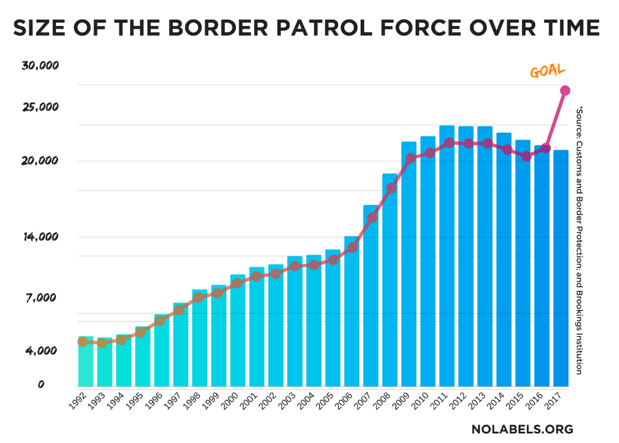
Today, there are 19,500 border patrol agents, up from fewer than 5,000 agents in 1992. Early in his tenure, President Trump authorized the hiring of 5,000 additional border agents, which would bring the size of the force to 24,500.
2. Each year, 1 million people cross the U.S-Mexican border legally in both directions.
Approximately $1.4 billion of legal goods and services cross the southern border each day. But according to a report by Reforma, a Mexican news service, the number of Mexicans legally entering the U.S. is dropping, with residents being deterred by longer wait times at the border and tougher immigration enforcement.
3. Since the start of the Trump administration, the number of people crossing all U.S. borders illegally has dropped dramatically.
According to the Associated Press, the number of people caught trying to illegally enter the country has dropped to 310,531 this fiscal year (October 1–September 30, 2017) from 415,816 the fiscal year before, the lowest level since 1971. During the Obama administration, the number of people arrested crossing the border also declined sharply. In fiscal year 2011, there were approximately 340,000 arrests made by border patrol, down from a peak of 1.6 million arrests in fiscal year 2000.
4. President Obama and President Trump both issued executive orders on immigration, bypassing congressional action.
In 2014, President Obama issued an executive order that expanded the DACA program and granted “quasi-legal”ustatus to 4 million parents of U.S. citizens or legal permanent residents. President Trump’s first executive order upon taking office banned citizens from Iraq, Syria, Iran, Libya, Somalia, Sudan, and Yemen from traveling to the United States. These are all countries President Trump believed posed a serious threat to American security.
5. According to the Department of Homeland Security, President Trump’s proposed border wall costs an estimated $21.6 billion. But Democrats argue it could cost three times that.
In April, Senate Democrats released a report estimating that President Trump’s proposed wall along the US-Mexican border could cost $70 billion to build and $150 million annually to maintain. The wall is still being negotiated. Last week, President Trump tweeted that there can be no DACA negotiations without the “desperately needed”ewall along the southern border.
No Labels is an organization of Democrats, Republicans, and independents working to bring American leaders together to solve problems.
