


Five Facts: Famous and Infamous FEMA Responses
In recent years, devastating late-summer hurricanes have become a new normal. The latest storm to hit the Eastern Seaboard is Hurricane Florence, which slammed into North Carolina earlier this week. As of now, more than two dozen deaths have been reported, 500,000 homes and businesses are without power and more than 30 inches of rain have fallen in pockets of the state.
When hurricanes and other natural disasters strike, the Federal Emergency Management Agency (FEMA) is charged with responding. Right now, the agency is on the ground in North Carolina; NPR reports that it has millions of bottles of water and meals ready, as well as urban search and rescue teams deployed.
But history has shown that FEMA’s response to emergencies can be varied. Below are five examples highlighting how the agency can respond well to a crisis, or hinder the recovery process after a natural disaster.
1. Bad: Hurricane Andrew
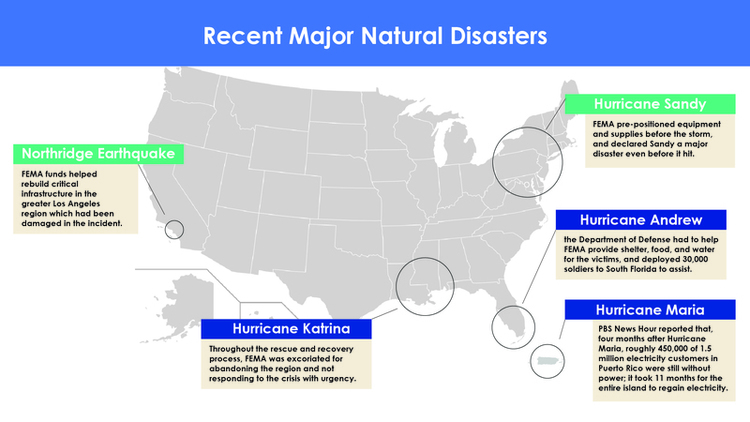
In 1992, Hurricane Andrew, a Category 5 storm, slammed into South Florida with 175 mile-per-hour winds and an unrelenting rainfall. Homestead, FL, was flattened, and 250,000 people were left homeless in Dade County (now Miami-Dade County). But FEMA took days to respond to the crisis; the response was so inadequate that Kate Hale, the emergency management director for Dade Country cried on TV, asking “where the hell is the cavalry?” Ultimately, the Department of Defense had to help the agency provide shelter, food, and water for the victims, and deployed 30,000 soldiers to South Florida to assist.
2. Good: Northridge Earthquake
In 1994, a magnitude 6.7 earthquake rattled the San Fernando Valley region of Los Angeles. The event killed more than 60 people, injured more than 9,000, and caused more than $40 billion in damage, which, according to CBS Los Angeles, was the costliest natural disaster up until that point. But, according to ThinkProgress, FEMA responded to the disaster in a way that was “immediate and extensive.” FEMA Director James Lee Witt held daily briefings to keep residents apprised of updates, and the agency gave grants of $3,000 to each displaced family shortly after the earthquake. And, over the long term, FEMA funds helped rebuild critical infrastructure in the greater Los Angeles region which had been damaged in the incident.
3. Bad: Hurricane Katrina
In 2005, Hurricane Katrina made landfall on the Gulf Coast, displacing more than one million residents in the region and damaging 70 percent of New Orleans’ occupied housing stock. Throughout the rescue and recovery process, FEMA was excoriated for abandoning the region and not responding to the crisis with urgency. According to a congressional report following the hurricane, many of the losses from the storm resulted from “questionable leadership decisions and capabilities, organizational failures, overwhelmed preparation and communication systems, and inadequate statutory authorities.” This includes FEMA not authorizing members of the New Mexico National Guard to deploy to Louisiana immediately, waiting two days to bring hundreds of volunteer firefighters in Atlanta to the region, and providing trailers with elevated levels of formaldehyde to victims.
4. Good: Hurricane Sandy
In 2012, Hurricane Sandy hit the Northeast United States, killing 147 people, causing $65 billion in damages, and bringing the region to a standstill. But FEMA’s received positive reviews for its response, both from elected officials and people on the ground. The agency pre-positioned equipment and supplies before the storm, and declared Sandy a major disaster even before it hit. The organization also worked closely with state officials to distribute supplies and reach populations impacted by the storm. President Obama specifically called for FEMA to eliminate as much red tape as possible to restore fuel and power immediately.
5. Bad: Hurricane Maria
In 2017, Hurricane Maria struck Puerto Rico with particular ferocity. The impact from the hurricane was catastrophic. Tragically, the death toll from the storm in Puerto Rico alone has recently risen from 64 to 2,975, following the release of a report by The George Washington University. PBS News Hour reported that, four months after Hurricane Maria, roughly 450,000 of 1.5 million electricity customers in Puerto Rico were still without power; it took 11 months for the entire island to regain electricity. And since the storm hit, the poverty rate on the island has increased 8 percent. In July, FEMA admitted that its response hindered Puerto Rico’s ability to recover. The Washington Post highlighted that the agency didn’t have enough people or resources on the ground after two recent hurricanes, and wasn’t able to seamlessly coordinate logistics. The New York Times reported that, when Hurricane Maria struck, “there was not a single tarpaulin or cot left in stock.”
No Labels is an organization of Democrats, Republicans, and independents working to bring American leaders together to solve problems.
