


In 1977, DOT Tried — And Failed — To Forecast Transit Scenarios

We’re four years from date that the U.S. Department of Transportation in 1977 tried to forecast transportation needs in one of four hypothetical scenarios — and are nowhere near any of them coming to fruition.
The DOT spent $225,000 — over $1 million in 2021 dollars – on a report to forecast transportation needs in the year 2025 under four separate scenarios—where the U.S. undergoes an Ice Age, becomes a dictatorship, is transformed into a hippy culture or blossoms into a society the authors deemed "the American Dream."
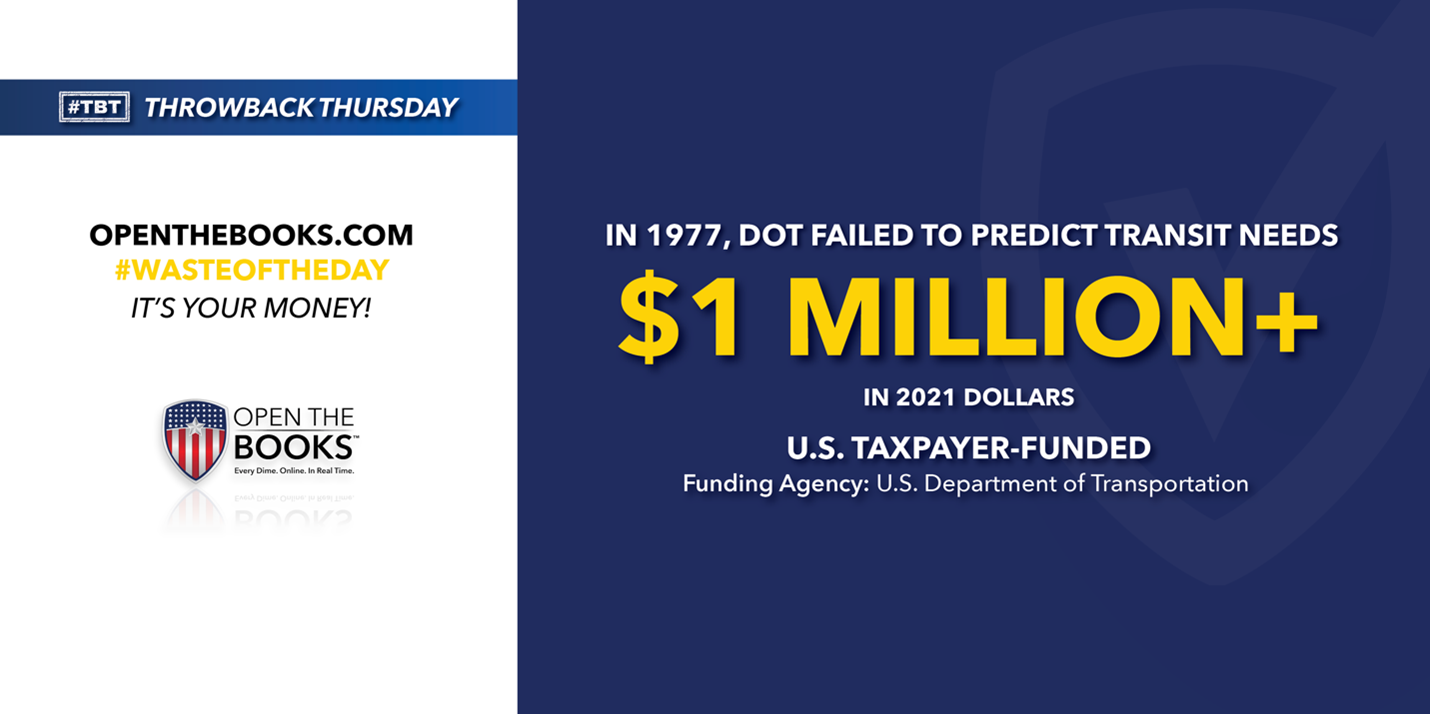
For this wasteful and nonsensical spending Sen. William Proxmire, a Democrat from Wisconsin, gave a Golden Fleece award in 1977.
“In its imaginary setting, its pursuit of the obvious and its predictions of the future, this is perhaps the most speculative, impractical and redundant study ever paid for by the government,” Proxmire said in giving the award.
The study predicted if there were an Ice Age, a "very large number of people" will be forced or attracted to move to the South and Southwest to escape an undesirable climate, Proxmire said then.
If there were urban guerilla warfare, cities would need more transit police, automobile use in afflicted regions would become risky, and damage insurance rates would rise, the study noted.
The cost per gallon of gasoline in 2025 would be $1.70 in an Ice Age, $1.50 in a hippy society, $1.85 under a dictatorship and $1.05 in a "success" future, the DOT determined.
The current national gas average is $3.28 per gallon.
Proxmire argued that a better use of taxpayer funds would have been for the DOT to examine the transportation implications if Congress were to abolish its futuristic research division.
The #WasteOfTheDay is presented by the forensic auditors at OpenTheBooks.com.
