


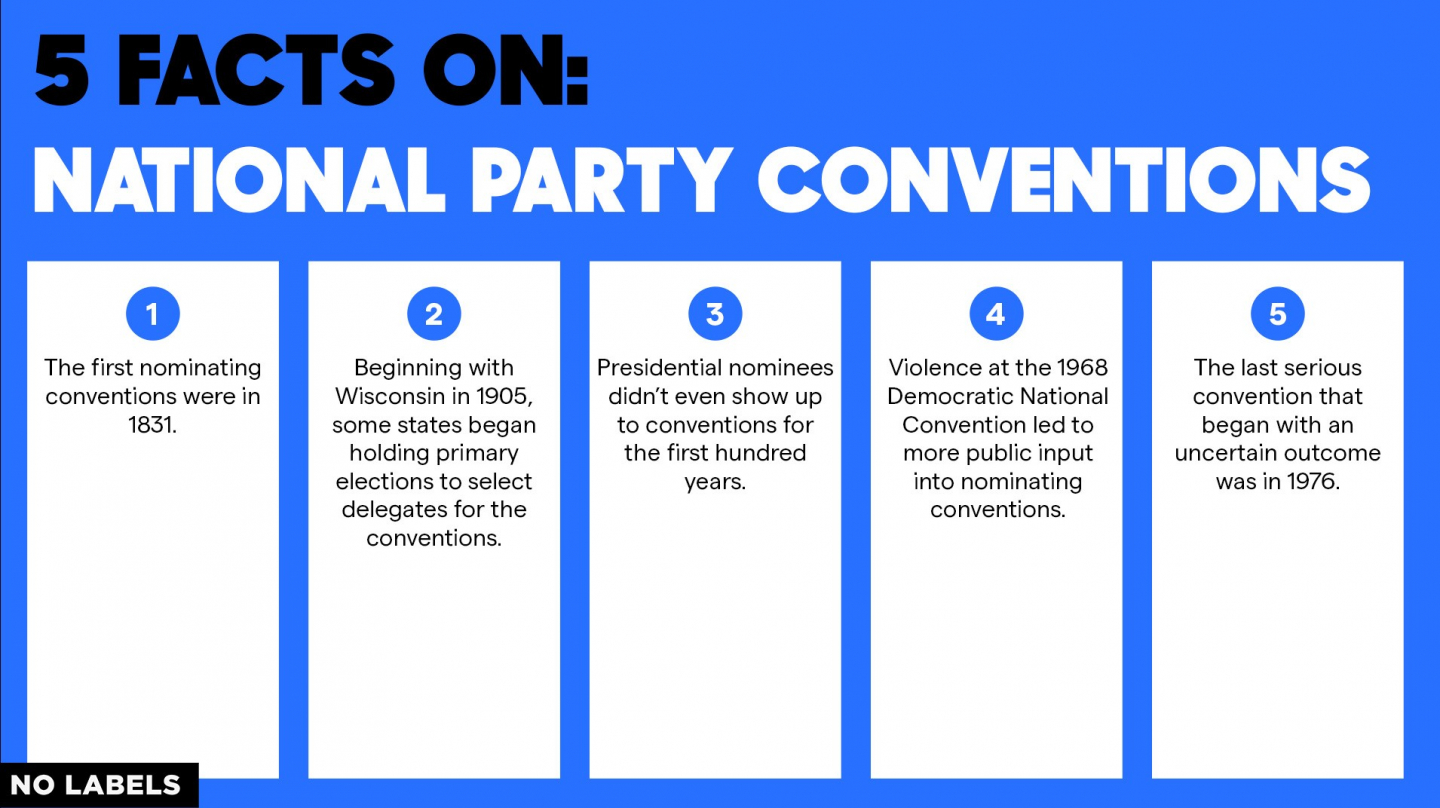
Five Facts on National Party Conventions.

Next summer, both Democrats and Republicans will host their 2024 national conventions. While today’s conventions are largely scripted affairs, they have historically been more freewheeling with often unexpected outcomes.
Here are five facts on national party conventions.
1. The first nominating conventions were in 1831.
The Anti-Masonic Party and the National Republican Party (different from today’s GOP) held the first nominating conventions in 1831. Delegates selected by state parties voted for presidential nominees publicly; before then, members of Congress would meet in secret caucuses to choose their party’s nominee. The Democratic Party held its first convention in 1832, making the practice permanent. Since then, the Whigs in 1836 were the only major party to not hold a convention.
2. Beginning with Wisconsin in 1905, some states began holding primary elections to select convention delegates.
Some states began holding primary elections so the public (which was previously defined to include only white men) could have some input in selecting their party’s presidential nominees. But the input was minimal: in 1912, former President Teddy Roosevelt won most of the Republican primaries yet ended up losing the nomination as the majority of convention delegates were unelected party insiders who supported the sitting President William Howard Taft.
3. Presidential nominees didn’t even show up to conventions for the first hundred years.
In fact, publicly campaigning for president at all was considered tacky. Presidents were supposed to be dignified and detached, and candidates had to play hard-to-get for voters to like them. It wasn’t until 1932 – a century after the first conventions – when Franklin D. Roosevelt broke the mold and attended the convention to accept the Democratic nomination, establishing the precedent we live with today.
4. Violence at the 1968 Democratic National Convention led to more public input into nominating conventions.
Chicago has hosted more nominating conventions than any other city, but none more infamous than the one in 1968. Tens of thousands of protesters – primarily united against the Vietnam War – swarmed the streets of the Windy City to support the popular antiwar Senator Eugene McCarthy over the Democratic insider Vice President Hubert Humphrey, who had not entered a single primary. Physical altercations inside and outside the convention lead to hundreds of arrests, dozens of injuries, and a fractured Democratic Party. Humphrey won the nomination but lost handily to Richard Nixon. By the time of the 1972 convention, Democrats had changed the rules to require all delegates to be allocated via primary elections.
5. The last serious convention that began with an uncertain outcome was in 1976.
While there hasn’t been a truly contested convention (in which delegates take more than one round of voting to select a nominee) since 1952, plenty of contests have gone down to the wire. The 1976 Republican convention saw incumbent but unelected President Gerald Ford narrowly beat Ronald Reagan after rule changes, shouting matches, and even physical altercations on the convention floor. Ford would go on to lose the general election to Jimmy Carter. Since then, the parties have cemented their nominees before the conventions began, presenting a unified front to start the general election campaign strong.
