


Why U.S. Antitrust Law Should Not Emulate European Competition Policy
Bottom Line: Reforming U.S. antitrust law so it more closely resembles Europe's is fundamentally at odds with sound economics, would undermine consumers, and constrain economic growth.
Some scholars and advocates argue that U.S. antitrust law should be “reformed” in order to invigorate antitrust enforcement and sidestep the judicially-imposed constraints that have developed over antitrust’s 100-year history. These efforts would make U.S. antitrust law more closely resemble competition law in Europe. While these scholars and advocates assert that their proposals would improve economic conditions in the U.S., economic logic and the apparent reality from Europe suggest otherwise.
There is much we can learn about the implications of these efforts by understanding the differences between U.S. and E.U. antitrust. Although the differences between U.S. and E.U. antitrust law can appear minor or superficial at a glance, even small differences can have important consequences, and the cumulative effect of the differences is significant. Although the Commission is often quite careful to couch its decision making in economic language, in practice, analytical economic administration of antitrust is far from the norm.
The proposals that would make U.S. antitrust law resemble that of the E.U. are varied — from calling for tougher structural presumptions and making predatory pricing claims easier to bring, to weakening the consumer welfare standard, punishing dominant firms simply for being dominant, and severely curtailing vertical restraints.
The differences between E.U. and U.S. competition policy, which if eliminated by U.S. reform would hurt consumers and the economy, include:
1) Precautionary principle vs. error cost framework - The E.U.’s “precautionary principle” approach, which is rooted in a belief that markets do not function well and are not sufficient to correct monopolization, would reduce U.S. entrepreneurship and economic dynamism.
2) Presumptions vs effects-based analysis - While U.S. antitrust law generally requires a full-blown, effects-based analysis of challenged behavior — particularly in the context of monopolization — the E.U. continues to rely heavily upon presumptions of harm or woefully truncated analysis.
3) Extraction of rents vs. extension of monopoly - The E.U. is willing to punish the mere extraction of rents by a lawfully obtained dominant firm, while the U.S. punishes only the unlawful extension of market power.
4) Non-economic factors and the politicization of antitrust vs. an economically grounded consumer welfare standard - The U.S. is guided by the consumer welfare standard, while the goals of European competition enforcers are both diverse, and often untethered from economic thinking.
Europe’s recent (and ongoing) experience with applying antitrust to both Facebook and Google presents a cautionary tale, not a model. There is no rigorous economic support for claims that high concentration levels are a strong indicator of harm to competition or that they should trigger a presumption of such harm in antitrust analysis.
A quick empirical analysis of the U.S. wireless sector shows that concentration is not a reliable predictor of either the health of competition or of consumer welfare. As concentration in the industry increased, wireless communications prices to consumers decreased — precisely the opposite of what a concentration-based approach would predict.
Read the full statement here.
No Correlation Between Market Concentration and Consumer Harm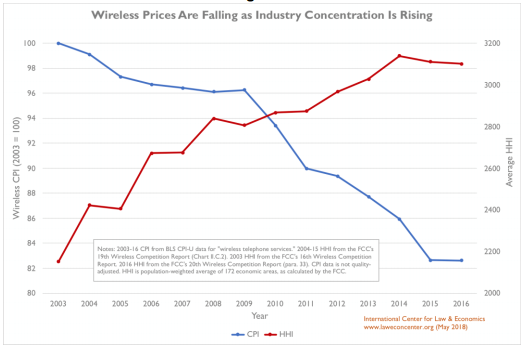
- As concentration in the industry increased, wireless communications prices to consumers decreased — precisely the opposite of what a concentration-based approach would predict.
- No rigorous economic support for claims that high concentration levels are a strong indicator of harm to competition or that they should trigger a presumption of such harm in antitrust analysis.
- Reforming U.S. antitrust law so it more closely resembles Europe's is fundamentally at odds with sound economics, would undermine consumers, and constrain economic growth.
