


About Romney Increasing Medicare Premiums

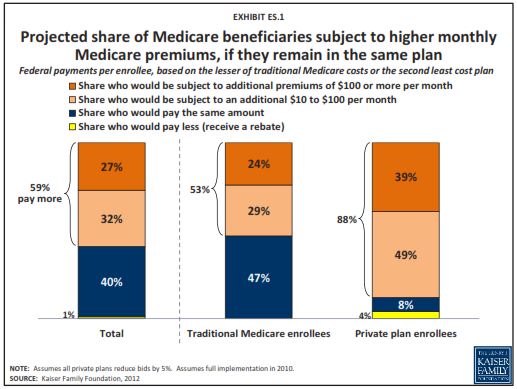
The Obama campaign is touting a new Kaiser Family Foundation study, claiming that it shows that Mitt Romney's Medicare reform plan would increase Medicare premiums for about 60 percent of seniors.
In fact, the KFF study does not assess Romney's plan specifically. It looks at a premium support model along the general lines of what Romney, Paul Ryan, and others have proposed. The key feature of such plans is that private plans are allowed to bid against traditional Medicare and one another to provide the same basket of services. Those bids determine the level of the federal subsidy that each senior uses to purchase either a private plan or the traditional Medicare package.
The KFF study finds that, if such a plan had been implemented in 2010, the subsidy would be below the cost of 60 percent of seniors' Medicare premiums, meaning that those seniors would have to either pony up to stay in their current plan, or switch to a cheaper plan.
Needless to say, this is a convenient finding for the Obama campaign so close to the election, even if the study technically isn't about Romney's plan.
That's too bad for the Romney campaign, because their plan probably wouldn't have come off looking as bad as the generic plan KFF modeled.
Here's why: the KFF study works by examining data from 2010 for traditional Medicare and Medicare Advantage plans, which are privately-administered health insurance plans offered through Medicare. The study's authors then look at the costs of different plans in each geographic area, and compare seniors' plans to the second-cheapest private plan available in that region. The idea is that Medicare Advantage plans can stand in for the private plans that would be offered in the Romney-style reform model.
The study found that 60 percent of seniors in 2010 had plans more expensive than the second-cheapest plan in the area, meaning that in a competitive-bidding model along the lines of the Romney plan, those seniors would either have to make up the difference out of their own pockets pocket or switch to the cheaper plan.
There are key differences, though, between the outline of the plan Romney's put forward and the assumptions the KFF study uses. In particular:
1. Romney calls for no changes to Medicare for 10 years, which means that the first seniors would enter the system not in 2010 but in 2023. The headline number in the KFF study - that 60 percent of seniors would see premium increases - rests on the assumption that there would be few or no seniors switching out of their existing plans to cheaper private plans. That seems like a fair assumption, given that folks are generally resistant to change. In the Romney plan, however, the premium support system would be phased in 10 years from now. New Medicare recipients would be choosing Medicare plans for the first time, and would probably be more likely to gravitate to the cheaper plan.
2. The KFF study doesn't include any of the cuts to Medicare and, especially, to overpayments to Medicare Advantage plans that will be taking place over the next 10 years as part of the Affordable Care Act. If those spending reductions all take effect, there would be less of a gap between the cheapest and the most expensive plans in each region, meaning folks in the expensive plans would have less of a difference to make up with their own money.
Furthermore, the KFF study doesn't take into account the strongest arguments in favor of, and against, the Romney plan.
Proponents of Romney-style competitive bidding reforms hope that competition would lead to drastically lowered costs as private plans and traditional Medicare bid against one another for seniors. KFF merely assumes a 5 percent, one-time reduction in the private plans' costs. In other words, the central mechanism is just assumed not to work as hoped. If competitive bidding worked in the way it's meant to, Medicare costs overall would decrease or level off, lowering seniors' premiums and, perhaps more importantly, making the program fiscally sustainable over the long run.
Critics of premium support plans like Romney's, though, argue that the private plans would seek out healthy beneficiaries and discourage unhealthy seniors, who have greater health care needs. Such cherry-picking could generate a situation in which all of the sicker Medicare recipients were shunted onto traditional Medicare, leading to unsustainable cost increases for that program.
The KFF study is bound to come up in the Obama campaign's talking points in the next few weeks. It's worth keeping its results in perspective. It doesn't present conclusive evidence against the wisdom of Romney's proposal or any of the other premium-support proposals going around Capitol Hill. In fact, its methodology is not too different from that of an American Enterprise Institute study that found that competitive bidding (with a distinct set of assumptions) would reduce Medicare costs by almost 10 percent over 10 years. Most importantly, the KFF study doesn't even address the strongest arguments for the Romney Medicare plan, nor the best arguments against it.
